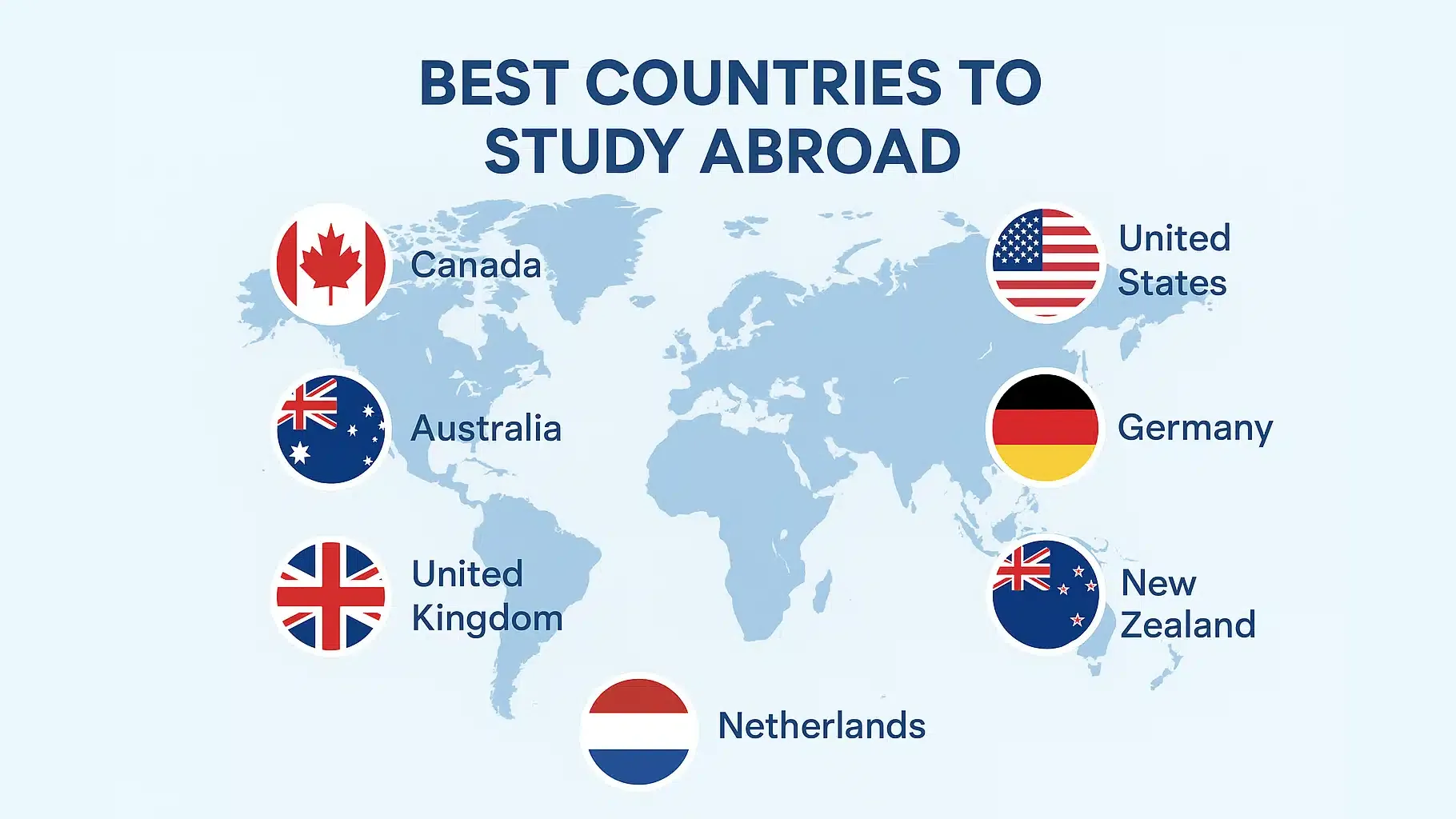
Choosing the right country to study abroad can shape your academic experience, career opportunities, cultural exposure, and long‑term goals. In 2025, several nations stand out as top destinations for international students thanks to quality education systems, post‑study work rights, scholarship opportunities, research excellence, and cultural diversity. This comprehensive guide breaks down the best destinations, what makes them attractive, and how to choose based on your goals.
1. Why Destination Choice Matters
Studying abroad isn’t just about academics — it’s a career and life decision. The country you choose affects:
- Quality of Education: Access to globally recognized degrees
- Work Opportunities: Internships and post‑study work visas
- Cost of Living & Tuition: Budgeting for education abroad
- Cultural Experience: Global exposure and adaptability
- Networking Potential: Access to international job markets
Tip: Match your academic and career goals with a destination that offers the best blend of opportunity and affordability.
2. Overview: Global International Student Trends
A recent OECD report shows that the majority of international students study in a handful of countries because of strong academic reputations and career prospects. Australia, Canada, France, Germany, New Zealand, the United Kingdom, and the United States collectively host around two‑thirds of international students in OECD countries. These places attract students for their reputation, post‑graduation opportunities, and quality of life. (OECD)
3. United States
Why It’s a Top Destination
The United States remains the most popular study destination in 2025 with more than 1.1 million international students enrolled in higher education institutions. Many of the world’s top‑ranked universities — like MIT, Harvard, and Stanford — are based here, offering excellent academic quality and research opportunities. (LinkedIn)
Highlights
| Feature | Details |
|---|---|
| Leading Universities | MIT, Harvard, Stanford, UC Berkeley |
| Strengths | Research excellence, diversity of programs |
| Work Opportunities | Optional Practical Training (OPT) |
| Cost Considerations | High tuition and living costs |
Tip: Many universities offer assistantships and scholarships that help offset costs for eligible international students.
4. United Kingdom
Why Students Choose the UK
The United Kingdom remains a top destination, with over 730,000 international students — making up roughly a quarter of all higher education attendees. It’s especially known for world‑class institutions like Oxford and Cambridge. (Wikipedia)
Highlights
| Feature | Details |
|---|---|
| Notable Universities | Oxford, Cambridge, Imperial College London |
| Program Structure | Often shorter degree durations (1 year for many Masters) |
| Post‑Study Work | Graduate Route allows work after studies |
| Cultural Diversity | Strong global student communities |
Note: Starting in 2027, the UK will rejoin the EU’s Erasmus student exchange programme, expanding mobility opportunities for students. (Reuters)
5. Canada
Why Canada Is Attractive
Canada’s appeal lies in its high quality of life, multicultural environment, and strong immigration pathways. Canadian universities consistently rank among the world’s best, and international students often have the option to work during and after studies under programs like the Post‑Graduation Work Permit (PGWP). (budgetabroad.com)
Highlights
| Feature | Details |
|---|---|
| Popular Universities | University of Toronto, UBC, McGill |
| Work Opportunities | Up to 3 years PGWP |
| Living Standards | High quality of life and safety |
| Cultural Diversity | Welcoming environment |
Tip: Many cities like Toronto and Vancouver offer vibrant job markets for graduates.
6. Australia
Consistent Growth and Quality
Australia has one of the highest ratios of international students to population, indicating its strong global appeal and openness to foreign learners. (Wikipedia)
Highlights
| Feature | Details |
|---|---|
| Top Cities | Melbourne, Sydney (both top 10 global student cities) (The Australian) |
| Strong Fields | Business, engineering, healthcare |
| Work Rights | Post‑study work visas available |
| Lifestyle | English‑speaking, multicultural environment |
Tip: Quality of life and international student services are strong reasons why Australia remains a top choice.
7. Germany
Affordable Excellence
Germany is known for high academic standards and low or no tuition fees at many public universities, even for international students. This affordability — paired with research strength in engineering and sciences — makes it attractive. (budgetabroad.com)
Highlights
| Feature | Details |
|---|---|
| Tuition | Often free or minimal at public institutions |
| Strengths | Engineering, science, business |
| Work Policies | Post‑study job search visas |
| Student Experience | Strong campus life and career support |
Trend: Recent increases in Indian student enrollment reflect Germany’s growing global appeal. (Reddit)
8. France
Culture and Cost Benefits
France combines affordable tuition with rich culture and academic excellence. Many programs in business, arts, and humanities are internationally respected. (budgetabroad.com)
Highlights
| Feature | Details |
|---|---|
| Famous Institutions | Sorbonne, Sciences Po |
| Cost | Relatively lower tuition |
| Global Networks | Strong European connections |
| Language | Courses in both French and English |
Tip: Learning French increases your experience and employability within the EU.
9. New Zealand
A Rising Star for Students
New Zealand’s popularity is growing rapidly, with international student enrollments increasing nearly 50% in recent years. Its high student satisfaction and welcoming environment make it a standout destination for 2025 and beyond. (The Times of India)
Highlights
| Feature | Details |
|---|---|
| Key Universities | University of Auckland, Victoria University |
| Student Satisfaction | Very high among international learners |
| Work Opportunities | Post‑study work visas available |
| Natural Beauty | Safe, scenic environment |
Tip: Strong research and innovation, especially in environmental sciences and technology, enhance employability.
10. South Korea
Growing Global Hub
South Korea is actively expanding its international education presence with initiatives like the Study Korea 300K project, aiming to attract 300,000 students by the late 2020s. (Wikipedia)
Highlights
| Feature | Details |
|---|---|
| Focus | Technology, engineering, business |
| Cultural Experience | Blend of tradition and modern innovation |
| Scholarships | Government and university funding options |
| Urban Life | Seoul, Busan offer dynamic living environments |
Tip: South Korea’s vibrant tech ecosystem appeals to students focused on innovation and digital careers.
11. Other Emerging Destinations
Beyond the major players, several other countries are becoming attractive for international students:
| Country | Key Benefits |
|---|---|
| Ireland | Academic quality + EU access |
| Netherlands | English‑taught programs and work visas |
| Spain | Affordable cost of living + strong culture |
| UAE | Emerging hub with scholarships and global campuses |
| Malaysia | Affordable tuition + multicultural environment |
Interest in alternatives like New Zealand, France, Malta, and the UAE is also on the rise, as students explore diverse and affordable options. (airc-education.org)
12. Cost of Living vs. Tuition Comparison
Studying abroad involves balancing tuition and living costs. Here’s a comparison of common destinations:
| Country | Tuition Trend | Cost of Living | Work Rights |
|---|---|---|---|
| USA | High | High | OPT available |
| UK | Moderate to High | High | Graduate Route |
| Canada | Moderate | Moderate | PGWP |
| Germany | Low/Free | Moderate | Job search visa |
| Australia | High | Moderate‑High | Work rights post‑study |
| France | Low‑Moderate | Moderate | Post‑study visas |
| New Zealand | Moderate | Moderate | Work visas available |
13. How to Choose Based on Your Goals
If You Prioritize Research & Prestige
Go for the USA, UK, or Germany with strong global university rankings.
If You Want Affordability
Consider Germany, France, or New Zealand for lower tuition and cost of living.
If You Want Work Opportunities
Look at Canada, Australia, and New Zealand, which offer extended post‑study work options.
If You Want Cultural Experience
Countries like France, the Netherlands, and South Korea provide rich cultural interactions alongside education.
14. Conclusion
Choosing the best country to study abroad in 2025 depends on your priorities — academic quality, affordability, work opportunities, cultural experience, and post‑graduation goals. Traditional leaders like the United States, United Kingdom, Canada, Australia, Germany, and France remain top choices, while destinations like New Zealand and South Korea are rapidly rising in popularity. Research ahead, match your goals with each country’s strengths, and plan accordingly to make the most of your international education journey.
For a detailed breakdown of top study destinations and trends, visit Top Countries for International Students 2025 | Atlas Apply.